

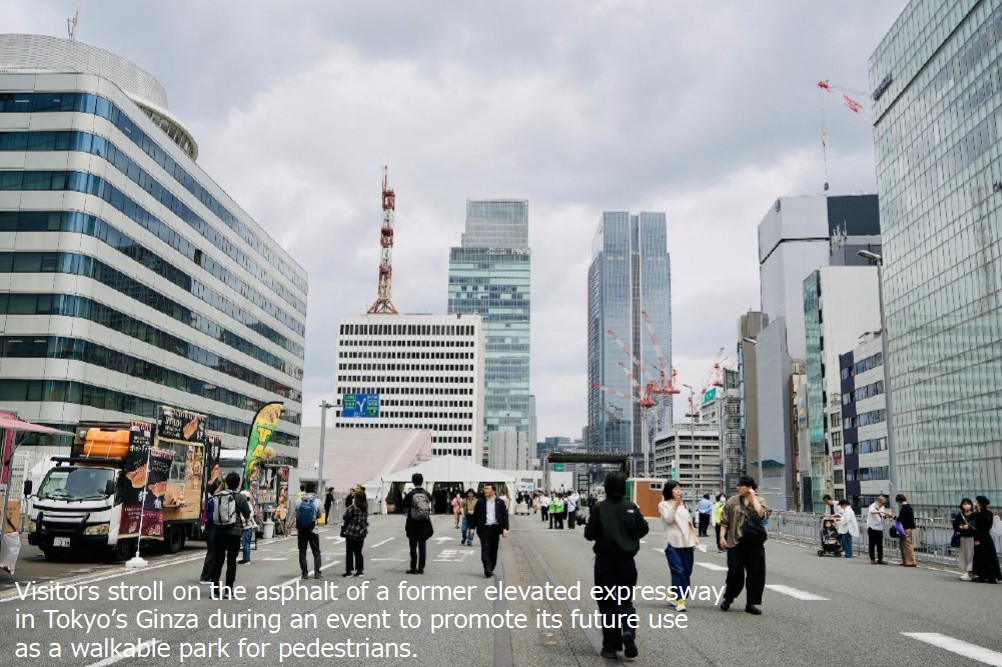
Some call it a “Sky Corridor.” Tokyo’s glitzy Ginza district is set to add another gem to its vibrant landscape—a pedestrian-friendly green space located 8.5 meters up in the air and stretching two kilometers long.
From what was once an elevated expressway, you can view the Imperial Palace surrounded by its moat and the greenery of Hibiya Park in the heart of Tokyo, through clusters of landmarks such as the Imperial Hotel and Tokyo International Forum. Superfast Shinkansen trains zip by in a close range outpacing commuter trains.
In the opposite direction spreads a panorama that sets Ginza apart from other metropolitan hubs—streets lined up with luxury brand flagship boutiques and premier department stores, as well as the depth of top-tier wining, dining and shopping options.
In the midst of it all, the midair park is gradually taking shape upon the roadway, which was decommissioned in April 2025 after skirting Ginza and alleviating traffic congestion there for more than 60 years.
Commonly known as the KK Line, the asphalt way spans the rooftops of 14 two-story commercial buildings—home to some 380 tenants including restaurants, bars, shopping centers, offices and parking lots. Now a bypass is due to be built underground to take over the traffic load borne by the KK Line—about 25,000 vehicles a day.
[Developing a ‘Walkable City’: Tokyo Governor]
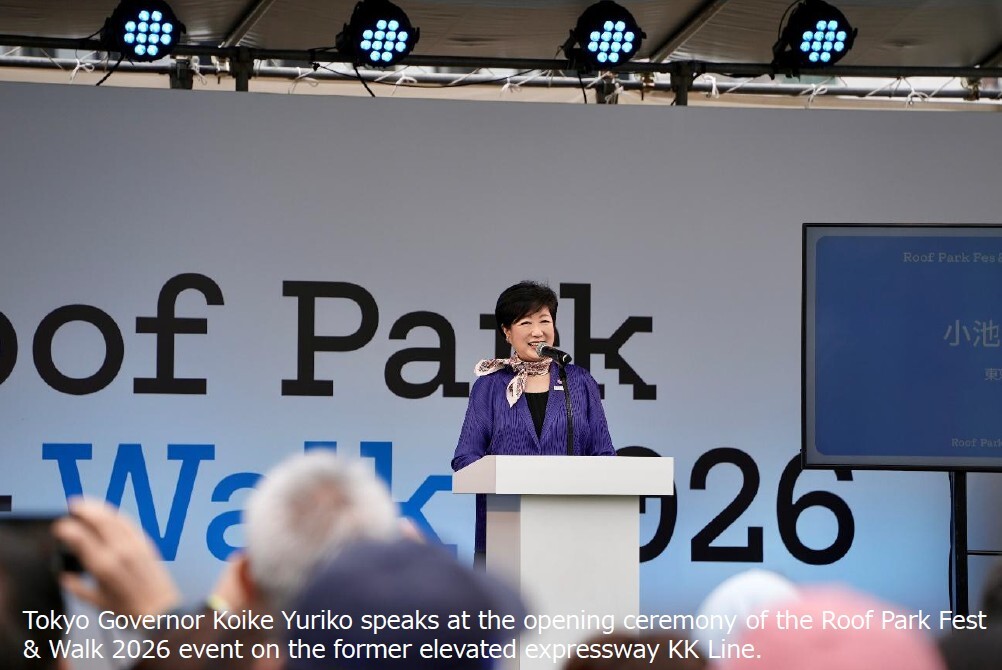
“This place is right in the heart of the city—you could almost call it a miracle of a space,” Tokyo Governor Koike Yuriko said in April at an event held on the KK Line to explore and promote its future use. “It is currently being reborn into a pedestrian-centered public space where people can gather, walk and enjoy themselves.”
She hoped to make the projected park Tokyo’s top destination for visitors from both home and abroad. “We want to go on with developing a lively and enjoyable city that is also walkable,” the governor told the event’s opening ceremony.
The regeneration process has been undertaken by the Tokyo Expressway Co., Ltd., which owns and manages the road and buildings, and the Tokyo Metropolitan Government (TMG), which owns the land underneath. The KK Line owner said in a statement that the project strives to develop not only the upper part but also the facilities and community underneath. “We aim to create a fun, welcoming space where visitors can always experience the thrill of climbing onto the roof and taking in a view that’s different from the usual.”
The road-to-park conversion ties in with Tokyo’s drive to build a sustainable future with human-centric urban planning. The KK Line event was positioned as a “partner event” of the global SusHi Tech Tokyo 2026 innovation conference hosted around the same time by the metropolitan government with the aim of creating “sustainable cities powered by high technology.”
The KK Line under renovation is planned to be partially opened to the public around 2030 and fully opened sometime between the 2030s and 2040s, according to the TMG Bureau of Urban Development.
At present, “technological and social experiments” are underway to determine how best to transform the former roadway into a space for pedestrians, said Hanaki Mariko, Tokyo Expressway’s Executive Managing Director in charge of the project.
“We have been conducting a wide range of experiments and studies,” she told the ceremony, adding that they were “conducting basic surveys such as measuring asphalt temperatures, exploring the reuse of materials previously used on the expressway, and seeking partners for greening technologies.”
A “Co-Creation Platform,” a panel embracing not only business operators but also experts from a wide range of fields, has been tasked to draw designs and details of the long-haul road-to-park project in partnership with local administrations, communities, citizens and corporations.
The KK Line regeneration project is often compared to New York’s High Line and Promenade Plantée in Paris. Each of them is a former elevated railway transformed into an aerial green walkway that draws large numbers of tourists. A renewed KK Line will be unique in that it is wider than the two others and is located in the heart of an urban commercial hub.
Website: Roof Park Project
[Breakdancing, Chalk-Drawing on the Asphalt]
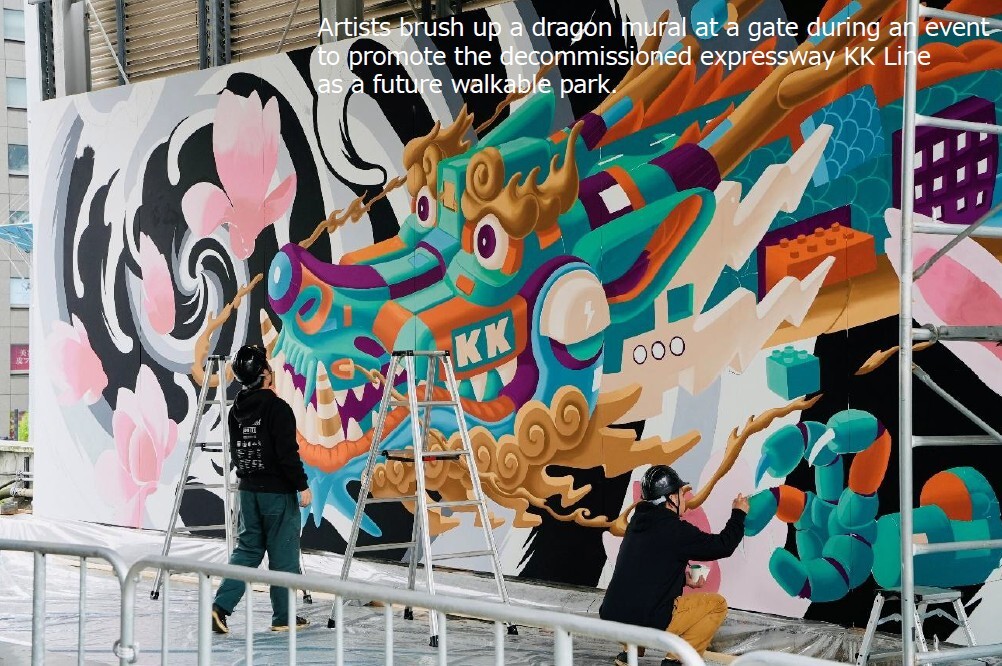
The KK-Line event, held on April 25-26 and dubbed Roof Park Fest & Walk 2026, turned the asphalt pavement, ranging in width from 12 to 33 meters, into a fairground and a walkway—featuring urban sports, playgrounds for children, family picnics and other recreational and educational activities. It lured 14,000 visitors.
Young people dabbled in skateboarding, breakdancing and Double Dutch rope jumping. Also on the asphalt, children drew pictures with chalk and played hopscotch. Senior and junior high school students attended a workshop on building their careers and communities. There were three other workshops where people made mud balls out of soil, had a picnic while discussing the KK Line’s possibilities and used Minecraft to build future town models.
Along the two-kilometer stretch, tents for exhibitions and specialty produce from different parts of Japan as well as rest areas equipped with a variety of benches and chairs were set up. Food trucks added to the carnival atmosphere, and so did street performers including a bubble artist.
Dozens of people gathered at the points which provided close-up views of Shinkansen bullet trains roaring by. Next-generation mobility vehicles, shaped roughly like scooters, also drew crowds for test drives.
“This is an area we are not usually allowed in. It’s my first time here, and I’m really enjoying it as a special experience,” a young mother told the ABEMA NEWS during the event’s first day. Her daughter chimed in, “I had a great time.”
On each morning at the event, early risers immersed themselves in yoga and jogging sessions. Live music performances and film screenings livened up the first-day evening.
[Waiting for ‘Real Greenery’ to Emerge]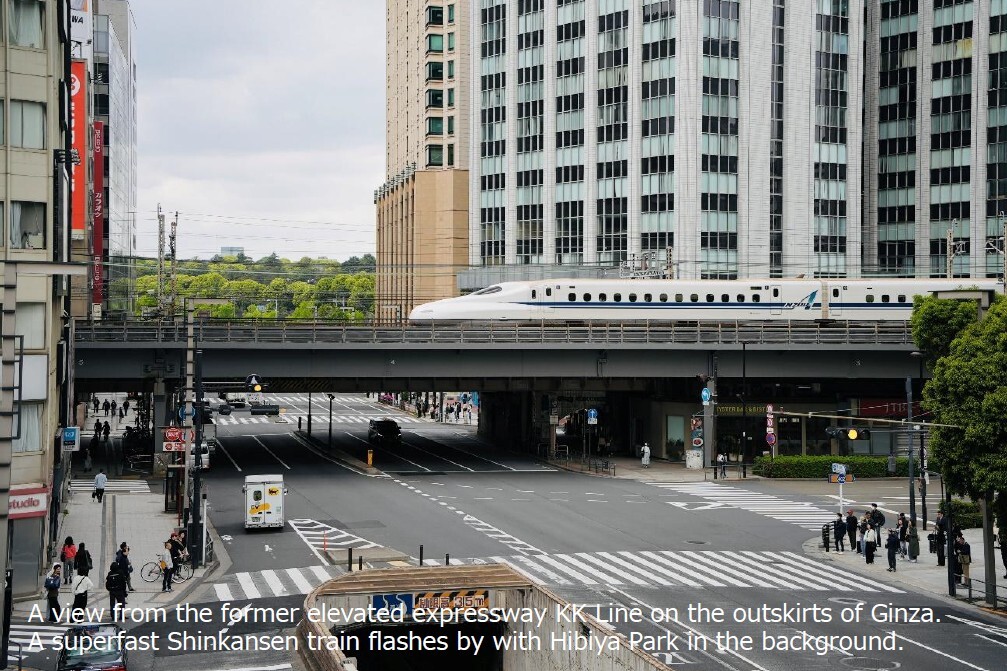
Under the Roof Park Project, lush green spaces are to be in place. The online news site Tetsudou (Railway) Channel noted, “Whether these green spaces will feature real grass, planters, or a row of small farms, we’ll have to wait and see.”
Another online news site commented what the expressway in Ginza had meant to people in the street. The Kuruma (automobile) News recalled that the KK Line was once full of taxis and limos carrying white-collar workers “straight into the heart of Ginza” on Friday nights and at the end of each month.
“It was also a popular driving spot because it offered a typical view of the city center.”
The KK Line event involving the participation of ordinary citizens was the fourth of its kind since 2023 when plans to convert the roadway into a pedestrian space were announced. It was the second since the expressway was decommissioned a year ago.
In the past year, the KK Line has also been used for various other occasions. They included a one-mile race and other events involving 2,300 runners on the eve of the World Athletics Championships in Tokyo last September and the Tokyo Deaflympic marathon races last November.
About 220 air-cooled Porche road and racing cars lined up on the KK Line in March in the first global “Luftgekühlt” (“air cooled” in German) event held in Japan. Luftgekühlt is a California-born annual car culture gathering focused on air-cooled Porsche models.
About 11,600 visitors attended the event in fine weather. “A generation of people have only ever driven on this elevated expressway,” Luftgekühlt creative director Jeff Zwart told the Porsche Newsroom. “And locals were really excited to walk around up here, celebrating the air-cooled world.”
In another example of utilizing the KK Line surface, American animated Sci-Fi film “The Wild Robot” was screened as part of a local SDGs film festival last October.
On February 18, a French luxury house staged a men’s fashion show on a runway set up on the KK Line, in honor of a designer who was retiring after decades working for the brand. From the runway, the luminous façade of the brand’s Ginza flagship could be seen.
[How the KK Line Has Evolved]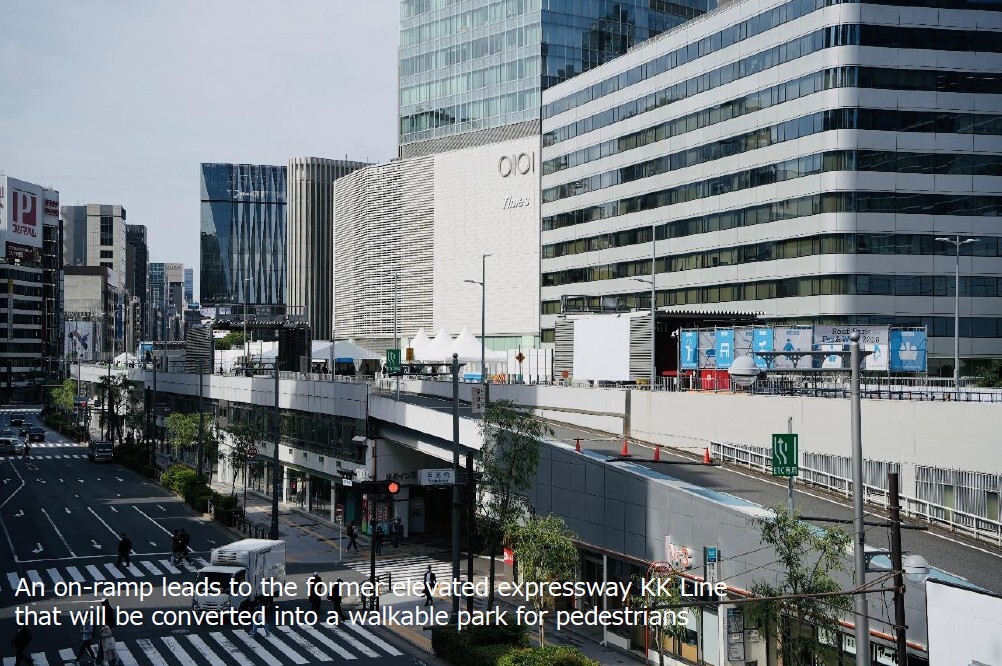
With funding from private corporations, the KK Line was built in phases between 1953 and 1966 to alleviate spiraling traffic congestion in Ginza as well as its upscale neighborhoods—Kyobashi, Otemachi, Marunouchi, Yurakucho, Hibiya and Shimbashi—after it rose back from the bombed-out ruins of World War II. A section of the Imperial Palace’s outer moat and two canals were filled in to erect the roadway and buildings that loop halfway around Ginza.
KK stands for kabushiki kaisha, meaning “company limited” in English, as the KK Line was owned and operated by a private entity. Since 1964, the KK Line was linked up with a citywide expressway network, the Metropolitan Expressway, newly developed and operated by a then public corporation, and contributed to traffic flow in the center of Tokyo.
The KK Line was decommissioned after the privatized Metropolitan Expressway Company decided to build a new underground bypass that would offset greatly reduce the role of the KK Line as an elevated expressway. Consequently, the space above the KK Line was planned to be converted into a public space mainly intended for pedestrians.
The underground bypass would also substitute an overhead Metropolitan Expressway section, which overshadows the historic Nihonbashi Bridge, which is one kilometer away from the northwestern exit of the KK Line.
The bridge served as the starting point of Japan’s five main national roads and a key water transport hub during the shogun-ruled Edo Period (1603-1868). The Nihonbashi area has retained its fame as a national center of commerce and finance to date.
Unlike the citywide expressway network, the KK Line was toll free as its construction and maintenance costs were covered with income from tenants in buildings under the asphalt road. One of the establishments is the 50-year-old live jazz club Ginza Swing.
Ginza Swing’s second-generation owner Iwamoto Hiroshi posted on YouTube a video showing him drive through the KK Line the day before its closure. “We have felt the vibrations below when trucks drive by here,” he said when his car reached the point right above his club.
“I’ve passed this way since I was in kindergarten and elementary school, so I feel a little sad,” he added. “Thank you for everything.”




Leave a Comment
You must be logged in to post a comment.